The Dominican Republic is often described as a Caribbean paradise, known for its turquoise beaches, world-class cigars, premium rum, and infectious music. Yet beyond tourism and tradition, the country has quietly built a powerful identity in a thriving beauty industry fueled by talent, discipline, and entrepreneurial ambition. In cities and towns across the island, beauty is not just aesthetic. It is business, investment, prime exportation to the U.S, and it is a carefully calculated asset woven into everyday life.
For Dominicans living in the homeland, the United States, and pretty much the rest of the world, weekend mornings tell their own economic story. Beauty salons fill before noon with women from every social background, each ready to dedicate hours—and resources—to maintaining their hair. Coffee cups or iced tea sit beside styling chairs. Transparent bags reveal premium shampoos and treatments purchased with intention. Under rows of dryers, clients observe, compare, and analyze results with the precision of seasoned investors. In this market, performance determines loyalty. Products are tested in real time, reputations are built quickly, and only what works survives.
Dominican consumers approach beauty with both emotion and financial intelligence. They are willing to invest in premium formulas, but only when those formulas deliver visible, lasting results. Locally developed brands hold particular value. They are seen as “tropicalized” creations—formulated with climate, texture diversity, and lifestyle in mind.
Supporting national talent is not merely patriotic. It is strategic. If a product understands the hair, it earns trust. And trust converts into long-term market power. Which makes it perfect to export to the diaspora.
Discover how Marielis Ramos built Hair Plus into a powerful beauty brand, turning resilience into business growth, financial strategy, and lasting assets.
Healthy, abundant hair is deeply embedded in Dominican identity. It represents care, discipline, pride, and resilience. That cultural priority has shaped a multi-million-dollar industry built on consistency and loyalty. Within this ecosystem emerged one of the most compelling entrepreneurial stories in the region: Marielis Ramos, founder and CEO of Hair Plus. Her journey from medical student to patient to beauty innovator is not only a story of survival—it is a case study in transforming adversity into intellectual property, brand equity, and scalable business assets.
Marielis Ramos did not set out to build a global haircare brand. Yet through resilience, calculated risk, and product innovation, she turned a deeply personal challenge into a profitable enterprise that now serves thousands.
Marielis Ramos turned a deeply personal challenge into a profitable enterprise that now serves thousands
In this conversation, we explore how she built Hair Plus from a hospital bed experiment into a recognized name in the beauty market—how she structured her finances, protected her assets, and positioned her company for sustained growth. Her story reflects perseverance and reveals the strategy behind building a brand in one of the most competitive beauty markets in the Caribbean.
“Believe deeply in yourself. Take the risk. Let go of shame.”
Marielis Ramos
In 2013, a tragic accident completely changed your life. How did that experience mark your life?
On August 11, I went away with friends and was in a devastating car accident that killed my best friend and another girl. I fought for my life between life and death, with doctors uncertain of my fate. I suffered multiple injuries—fractured femur, pelvis, and cervical fracture—and spent a year unable to walk, a month in intensive care, and underwent twelve surgeries. What was meant to be a short trip became a life-altering event.
Following your complex cervical surgery and the necessity of wearing a neck brace, your hair became tangled, prompting you to cut it. What did you learn from letting go of something that, in many Latin countries, is regarded as a symbol of femininity?
Honestly, it felt like my world was falling apart. I was already battling depression, and cutting my hair felt like the final straw. My hair was so tangled that the scissors broke, so they had to use clippers. What happened afterward eventually led to Hair Plus, and I gained insight into why many women attach so much importance to their hair. For many of us, it’s a core part of our self-esteem. When our hair is styled—regardless of texture or length—we feel incredible.
Your decision to cut your hair inspired you to explore traditional beauty remedies. Mixing these with your creativity, you developed a shampoo that quickly gained popularity and expanded into a complete product line, becoming a worldwide brand. What was the origin of this idea?
Since I had a lot of free time, I watched a lot of TV. I was watching a show, and the hosts were discussing hair growth, and I was always interested in beauty. Committed to regrowing my hair, I continued watching shows, YouTube videos, and reading books on the topic. Since I couldn’t walk, I asked my mom to cut her garden’s aloe vera. I started blending it with ingredients like onion and honey. I made large batches, sharing leftovers with visitors. Over time, those visitors began asking for more shampoo, and I realized I had something valuable.
Her story reflects perseverance and reveals the strategy behind building a brand in one of the most competitive beauty markets in the Caribbean.
Instead of formulating products, why didn’t you check what was available online for your situation. What market problem did you identify that others weren’t seeing?
I honestly wasn’t evaluating markets. I mean, I didn’t have that kind of expertise to really understand a business or anything like that.
I just wanted to do something to entertain myself, something for personal use. Not so much with a business plan in mind or to sell it, but more as something that I enjoyed. When people came over to my house, I would give it to them.
It was more for that purpose, you know? Not so much for commercial reasons. For me, it was simply a form of entertainment.
What decision did you make when you still didn’t have enough data to feel confident?
Back in 2014, during Holy Week, I posted on Instagram saying that I was selling hair growth shampoo, and people started messaging me. The Instagram page I had was focused on tips for hair growth.
At that time, there were no direct messages and no Stories. The only thing people could do was comment on your photos. So they would comment saying they were interested.
When I saw that there were people interested from different parts of the country, I thought, ‘wait a second, I need to sell this in more cities.’ That’s when I started selling it outside of La Vega, which is where I was making it. I began shipping it to other places through delivery and transport companies.
First, I had to research how I was even going to ship it, because I had no idea how that process worked. And second, I remember that I didn’t even have a bank account at the time. So I said, ‘I need to open a bank account so people can pay me.’
Did you apply for a loan to launch your business?
And when I say everything was manual labor, I mean it. I didn’t even grow the ingredients myself. Since production was small at the time, people would give me ingredients from the countryside. I’d call my neighbor or a farmer and say, “Can you please give me some aloe vera? or If there’s aloe vera around, please send it to me!”
I didn’t have to make a big investment back then. The shampoo bottles I used cost 13 Dominican pesos each. I was working from home. The internet I used was my mom’s home internet, so I didn’t have to pay for a separate plan.
That’s something I always say: start where you are. Don’t wait to have the perfect store or setup. I didn’t have a car. I got around by taxi. I didn’t have resources. No one gave me money.
About nine months after founding the business, I realized I needed a vehicle. My dad let me use his credit and signed as a guarantor, but I was the one who paid for my first car and everything else.
The business began in a house my father owned. However, the money I used to pay for my studies in cosmetic chemistry in Argentina came from my own savings generated by the business. My parents were unable to cover my post-accident education because the massive, exorbitant expenses incurred after my accident had virtually depleted their resources.
“Start where you are. Don’t wait to have the perfect store or setup.”
Marielis Ramos
That challenge brings to mind how quickly people can lose money or incur debt. Considering that, what was the most significant investment mistake you made in your business, and what was the financial impact?
Two years after Hair Plus was founded, when you start understanding business, and you see something working, you naturally want to try more things. That happened to me. I tried to open a pharmacy in my hometown, La Vega, and it was a complete failure.
At the time, I invested one and a half million Dominican pesos, which was a lot of money for me. I lost it. I didn’t do proper research, and that’s why it’s so important to really educate yourself and fully understand what you’re getting into before starting a business.
I had already registered the name, FarmaPlus. I rented the location. I ordered all the furniture to be made. And then I found out there was a law stating that pharmacies have to be a certain distance apart and cannot be too close to each other.
That was a major loss for me.
How do you separate your personal finances from your company’s finances?
First, you have to keep your feet on the ground. Second, if you let yourself be carried away by social media, you’ll end up losing your mind, because there will always be people who seem to be doing better than you, and there will always be people who live to keep up appearances.
I always say: ‘On Instagram fancy we see, but there might be debts we don’t know about.’
Do you pay yourself a fixed or variable salary, and how did you determine it?
I have a salary, and my husband does too. That helps me stay organized with my finances. And I’m also a resource for the company. For about three years now, I’ve been the main face of the brand. So the brand has to pay me for being its image. That’s something many people don’t see.
What the company saves by not paying a major influencer, it pays to me instead — not on that massive scale, but I still do the work. It may sound funny, but it makes complete sense.
“There will always be people who seem to be doing better than you, and there will always be people who live to keep up appearances.”
Do you use corporate credit cards? How important is it for your business to have one?
For example, we use corporate credit cards for any business expense, even if it’s something small. That’s something I consider valuable.
What types of assets are you currently investing in (real estate, startups, stocks, index funds)?
I invest my money in real estate.
In 2015, I bought my first property, which was a house in La Vega. I rented it out myself. I was the realtor — I showed it to clients and handled everything.
Later, I bought a commercial space, and today we’ve expanded the portfolio.
I’ve never invested in the stock market. I find it very interesting, but we’ve stayed focused on real estate.
If Forbes were to evaluate your business, how much do you think it would be worth? Would a billion dollars surprise you, or do you believe in your business so much that you think it’s worth that or even more?
I believe in my business, and I know I’ll get there. I’m not there right now, but I know, in God’s name, I will reach that point.
Do you see yourself selling the company? Do you see yourself passing it down? Do you imagine your children carrying it forward from generation to generation?
Right now, my husband and I are working as a team to sustain and grow the company as much as we can. I don’t want to automatically pass that responsibility on to my children because I don’t know if that’s what they’ll want. I want them to be happy. I don’t want to hand them that commitment if they don’t desire it.
Now, if they choose to continue the legacy, we would be happy with that. It’s something my husband and I talked about even before having children. But I don’t want to raise them thinking, “You’re Hair Plus, you have to dedicate your life to Hair Plus.”
Are you the majority or sole owner? Have you received offers to sell Hair Plus?
My husband and I are business partners. I own the company 100%. We have had proposals to sell, but we are not interested at the moment. We have a game plan that will help us become a billion-dollar company.
“We have a game plan that will help us become a billion-dollar company.”
Marielis Ramos
What message would you give to women who want to become self-made millionaires and build wealth from scratch?
First, believe deeply in yourself. Take the risk. Let go of shame. If you’re embarrassed to speak, to show up, to promote what you do, that will hold you back. You have to know how to sell, especially in the century we’re living in. That’s not optional anymore.
And another thing: find what you’re truly good at. Every single one of us was born with talent. The real task is to explore it — to figure out what you were called to do and why you’re here on this earth.

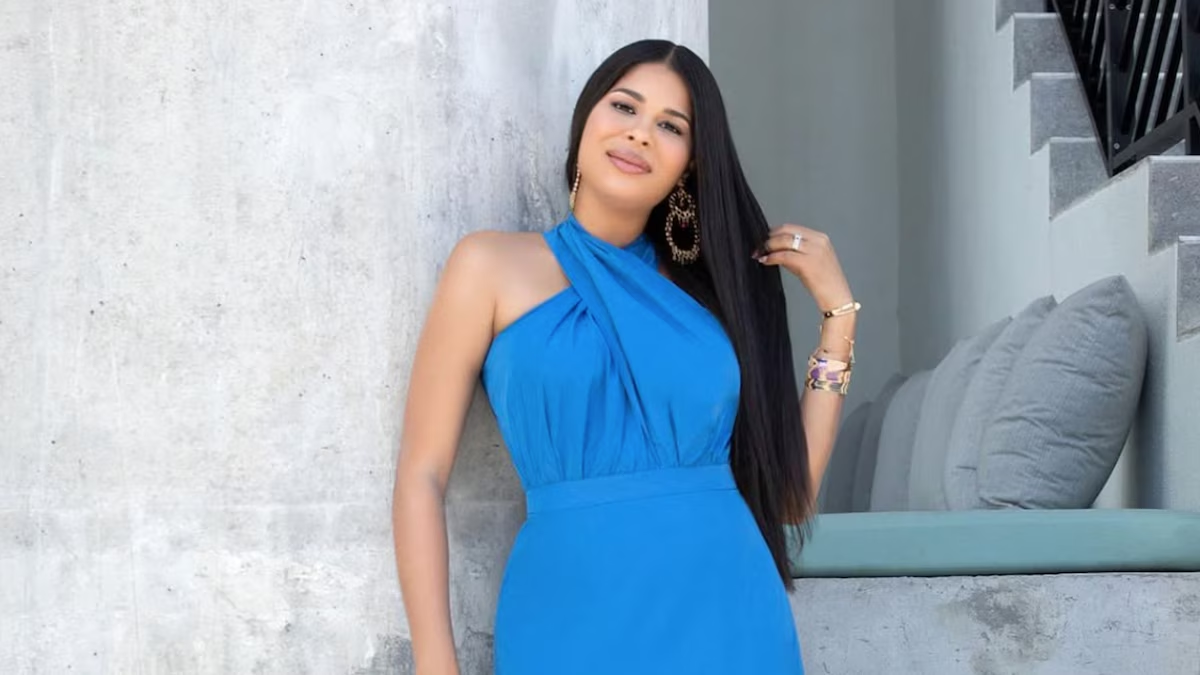
 © Courtesy of Marielis Ramos
 © Courtesy of Marielis Ramos
 © Courtesy of Marielis Ramos
 © Courtesy of Marielis Ramos
 © Courtesy of Marielis Ramos